
Poker Positions Explained: Where Do You Sit in Texas Hold'em?
A beginner-friendly guide to the common positions around a Texas Hold'em table and why they matter.
What Does Position Mean in Poker?
In Texas Hold'em, your position describes where you are sitting in relation to the dealer button. Your position determines when you act during a hand.
This is important because players who act later get to see what other players do before making their own decisions. That extra information can be a major advantage.
The positions move one seat clockwise after every hand, along with the dealer button. That means you will play from every position during a typical home poker game.
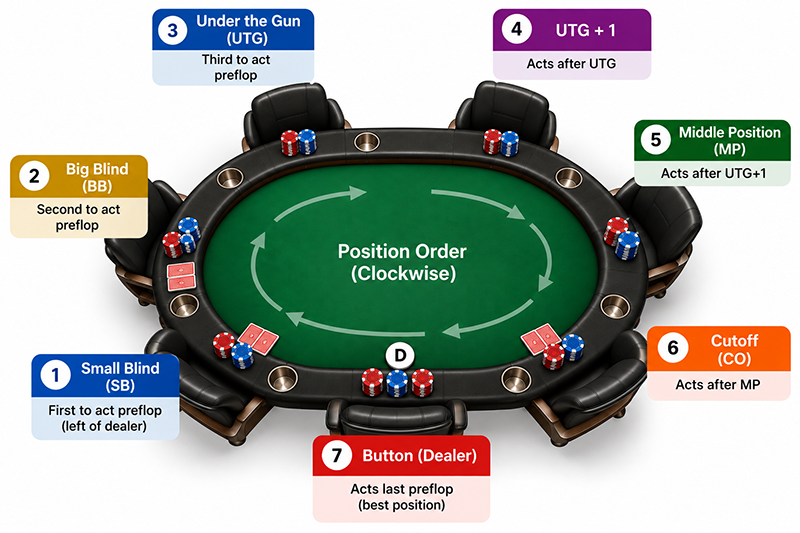
The Dealer Button
A small round marker called the dealer button, or simply the button, identifies the dealer position for the hand.
In many home games, the player on the button may actually deal the cards. In games with a dedicated dealer, the button still moves around the table so the betting positions continue to rotate.
Since most home games do not have a dedicated dealer, the player that is actually dealing is (guess what?) the dealer. In that case the use of the plastic button labeled 'Dealer' is not really needed. Some players, however, feel more comfortable using a dealer button...(?)
The button is an important position because after the flop, the player on the button normally acts last. Being able to see what the other players do before making a decision is valuable.
The Small Blind
The player immediately to the left of the button is the small blind.
Before the cards are dealt, this player must put a required bet into the pot. The small blind is normally one-half of the big blind, although the exact amount depends on the rules of the game.
The small blind has a difficult position after the flop because this player usually acts first.
The Big Blind
The player immediately to the left of the small blind is the big blind.
The big blind must also place a required bet before receiving any cards. The size of the big blind is generally the basic betting amount used to describe the stakes of the game.
For example, in a $1/$2 game, the small blind is normally $1 and the big blind is $2.
Under the Gun
The player immediately to the left of the big blind is commonly called Under the Gun, often abbreviated UTG.
Under the Gun is the first player to act before the flop. The name comes from the fact that the player must make a decision before seeing what any of the other players will do.
Because there are several players still waiting to act, beginners should generally be more selective about the hands they play from this position.
Middle Position
The seats between the early positions and the later positions are generally called middle position.
The exact number of middle-position seats depends on how many people are playing. A nine-player table has more positions to name than a six- or seven-player table.
From middle position, you have already seen some players act, but several players may still act after you.
The Cutoff
The seat immediately to the right of the dealer button is called the cutoff, often abbreviated CO.
This is considered a late position. Only the player on the button acts after the cutoff before the blinds preflop, so the cutoff often has more information than players in earlier positions.
As you gain experience, you will usually find that you can consider playing a wider selection of starting hands from the cutoff than from early position.
The Button
The button is generally the strongest position at the table because the player on the button acts last after the flop, turn and river.
Suppose two opponents check before it is your turn. You now know that neither chose to bet. If one of them had made a large bet instead, you would have that information before deciding what to do.
This does not mean that every hand should be played from the button. It simply means that acting later gives you more information when making your decisions.
Early, Middle and Late Position
You will often hear poker players group individual seats into three general categories:
- Early position: Players who must act relatively early and have less information about what the other players will do.
- Middle position: Players seated between the early and late positions.
- Late position: Usually the cutoff and button, where players get to see more of the action before making decisions.
These categories are useful because poker strategy often changes depending on whether you are in early, middle or late position.
Why Position Matters
Imagine that you have a hand that might be worth playing, but you are not sure how strong it is.
If you are one of the first players to act, you do not know whether someone behind you plans to raise. If you are near the button, you may see several players fold before your turn. That additional information can make your decision easier.
Position can affect whether you should enter a hand, bet, call, raise or fold. It is one of the most important concepts for a new player to understand after learning the basic rules and hand rankings.
Position Changes Every Hand
One of the nice things about a home poker game is that no one keeps the best position permanently.
After each hand, the dealer button moves one seat clockwise. The small blind, big blind and all the other positions move with it.
If you are Under the Gun during one hand, you will eventually move through middle position, the cutoff and the button as the game continues.
Position at a Short-Handed Table
Home games do not always have a full table. You might have six players one week and eight players the next.
The button, small blind and big blind are always easy to identify. The names assigned to the remaining seats can vary somewhat depending on the number of players.
For a beginner, it is more important to understand the basic idea than to memorize every possible seat name: the earlier you must act, the less information you have; the later you act, the more information you have.
A Simple Position Strategy for Beginners
You do not need complicated charts to begin using position in your game. Start with one simple idea:
Play more cautiously from early position and consider more opportunities when you are in late position.
As you become more experienced, you can learn which starting hands are appropriate from each position and how position affects betting after the flop.
The Bottom Line
Poker position simply tells you where you sit in relation to the dealer button and when you will act during the hand. But that simple difference has a major effect on poker strategy.
Learn to recognize the button, small blind, big blind, Under the Gun, middle positions and cutoff. Once you become comfortable identifying them, start paying attention to how much more information you have when you act later in the hand.
Understanding position is an important step toward becoming a more thoughtful Texas Hold'em player.